


Nurturing seafood to grow
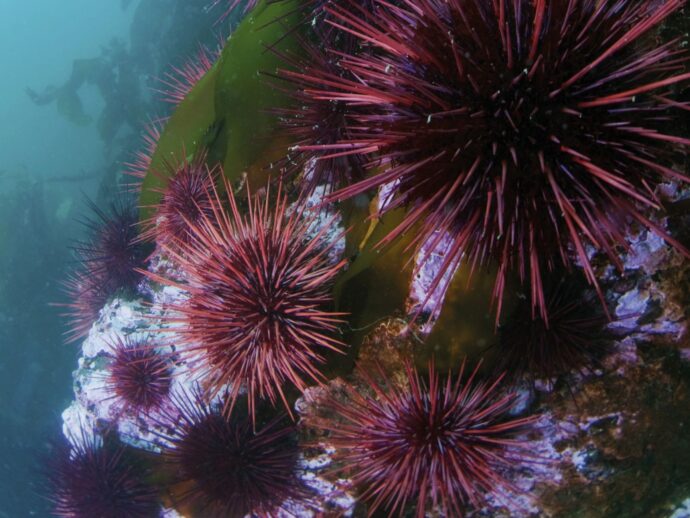
The objective of “Chiix̱uu Tll iinasdll: Nurturing Seafood to Grow” project, an initiative aimed at restoring an area of kelp forest in Gwaii Haanas between 2017 and 2021, was collecting urchins to help rectify the area’s unbalanced food chain. Sea otters were important consumers of urchins before their local extinction during the maritime fur trade of the 18th and 19th centuries.
Without predation, urchins have become hyperabundant, leading to the overgrazing of kelp, an important cultural resource to the Haida Nation, as well as an integral component of the world’s biodiversity and environment.
Kelp lives near shorelines around the world and helps to nourish and house important underwater life. Much like forests on land, kelp’s photosynthesis process absorbs carbon dioxide, nitrogen, and phosphorous and releases oxygen—an important system in slowing the rate of climate change.
But the Haida Nation isn’t the only area grappling with kelp loss. More than half of kelp forests worldwide have declined in the past 50 years, jeopardizing coastal biodiversity, water quality, and atmospheric carbon levels.
An overlooked issue
Underwater gardens are disappearing at alarming rates due to factors like habitat destruction, overharvesting and overgrazing, and pollution. Other challenges include climate change and sedimentation caused by runoff from deforestation, dredging, or storms. And, while ocean conservation has been around for decades, kelp preservation and restoration are relatively new.
A 2021 paper published in the Frontiers in Marine Science journal measured the invisibility of kelp forests in international environmental governance. Researchers found that for every mention of kelp forests, seagrass meadows were mentioned seven times, salt marshes 20 times, coral reefs 38 times, and mangroves 43 times.
A global call to action
In 2023, The Kelp Forest Alliance launched the Kelp Forest Challenge, a global movement calling on everyone—from individuals to corporations and governments—to join the challenge of restoring 1 million hectares and protecting 3 million hectares of kelp forest habitat by 2040.
Measures to restore and preserve kelp forests begin with the identification of their causes for decline. Controlling urchin populations or cleaning polluted water and sedimentation can help conserve threatened kelp, while seeding or transplanting baby kelp can aid in the growth of new forests.
While countries like Japan and Korea have a long history of restoration efforts, and regions like California and Washington state are building conservation and restoration frameworks, to date, the Kelp Forest Challenge is the only conservation initiative that exists at an international level.
An interconnected system
In Haida Gwaii, the Haida Nation’s ethics and values serve as their guiding principles. Gina ‘waadluxan gud ad kwaagid, which means interconnectedness—an understanding that everything depends on everything else—serves as an important reminder about the biosphere’s fragility and vulnerability.
by Alexa Everett